
Glass Imaging | Glass AI | When AI change the rules of optics
Updated: Aug 8, 2024
Smartphone cameras have not yet dethroned DSLR cameras in terms of image quality. However, these compact cameras, equipped with state-of-the-art optics, sensors, actuators, and the latest ML/AI algorithms, are already competing with DSLRs when considering the quality of images straight out of the box and the ease of instantaneously sharing videos and pictures through social media or messaging apps.
The only - but major - barrier for smartphone cameras to truly compete with DSLRs is linked to optics. The flat and compact form factor imposed by smartphones restricts the size of the sensor and optics. To increase image quality, you need to gather more light, which requires larger pixel sizes and lens diameters. It's simply not possible to increase the size of the sensor and optics in a smartphone using conventional methods.
This is where Glass Imaging's AI Glass comes in. The genius idea behind AI Glass is to redefine optical and sensor solutions by leveraging the power of AI. This involves "deforming" the optics and the sensor to make them more "flat." At the hardware level, this means using anamorphic-type lenses, panoramic sensors, and tilting mirrors.
Let's dive into these innovations by exploring three distinct patents filed by Glass Imaging:

Learn more on Glass Imaging website.
Patent application:
ANAMORPHIC LENS SYSTEM WITH LENS MOUNTING STRUCTURES
US20240151950A1
Glass Imaging Inc

Bibliographic data:
Publication date: | 2024-05-09 |
Application date: | 2023-11-07 |
Priority date: | 2022-11-07 (US202263423196P) |
Application number: | US18504060 |
Current assignee: | Glass Imaging Inc |
Inventors: | ATTAR ZIV, COGSWELL COLE ALEXANDER |
CPC classification: | G02B 13/08 G02B 7/021 |
IPC classification: | G02B 7/02, G02B 13/08 |
Legal status: | ACTIVE (Pending) |
Family status: | ACTIVE |
External links: |
A. What is the invention?
The invention is an anamorphic lens system that includes two lenses with interlocking mounting structures. Specifically: - The first lens has an asymmetrical optical component and a first mounting structure with walls and gaps. - The second lens has an asymmetrical optical component and a second mounting structure with barriers and protrusions. - The protrusions on the second mounting structure engage with the gaps on the first mounting structure, providing passive rotational alignment of the asymmetrical optical surfaces about the optical axis.
B. How does it work?
When the second lens interlocks with the first lens, the protrusions on the second mounting structure engage with the gaps on the first mounting structure. This engagement passively aligns the asymmetrical optical surfaces of the two lenses about the optical axis. Additionally, the walls on the first mounting structure can engage with the barriers on the second mounting structure to provide lateral alignment of the lenses perpendicular to the optical axis.
C. What is new?
The key new aspect is the use of interlocking mounting structures to enable passive rotational alignment of the asymmetrical lenses, without the need for external mechanical support structures. Conventional lens systems rely on external lens barrels or housings to align and hold the lenses in place. The interlocking mounting structures described in this patent eliminate the need for those external support structures.
D. Why is it useful?
The invention addresses issues with conventional lens systems that use external mechanical supports for alignment. Those external supports can be tedious to use and may not provide accurate rotational alignment, especially for asymmetrical lenses. The interlocking mounting structures in this patent enable passive rotational alignment of the asymmetrical lenses. This can improve optical performance, reduce manufacturing errors, simplify assembly, and increase durability. The lens system can be useful in applications like phone cameras, wearable devices, and AR/VR headsets where precise lens alignment is important.
Patent application:
IMAGING SYSTEM WITH MOVABLE NON-SYMMETRIC LENS
WO2023196650A1
GLASS IMAGING INC

Bibliographic data:
Publication date: | 2023-10-12 |
Application date: | 2023-04-07 |
Priority date: | 2022-04-08 (US202263329045P) |
Application number: | US2023017965 |
Inventors: | ATTAR ZIV |
CPC classification: | G02B 13/001 G02B 7/34 G03B 13/32 G03B 3/02 G03B 5/00 |
IPC classification: | G02B 7/04, G02B 15/14, G03B 13/32, G03B 3/02, G02B 13/00, G03B 17/12, H04N 23/55, H04N 23/54 |
Legal status: | ACTIVE |
Expiration: | 2024-11-08 (31 months limit, exceptions may apply) |
Family status: | ACTIVE |
External links: |
Symmetric vs asymmetric lenses:
The fundamental difference between symmetric and asymmetric (non-symmetric) lenses is: Symmetric lenses:
- Have the same optical power (focal length) along both the x and y axes.
- The surfaces of the lens are symmetric about the optical axis.
- They focus light equally along the x and y dimensions.
Asymmetric (non-symmetric) lenses:
- Have different optical powers (focal lengths) along the x and y axes.
- The surfaces of the lens are not symmetric about the optical axis.
- They focus light differently along the x and y dimensions, creating an astigmatic effect.
The key point is that symmetric lenses have the same optical properties in all directions, while asymmetric lenses intentionally introduce different optical powers and focusing effects along different axes. This allows asymmetric lenses to be used to achieve different magnifications or distortions along the x and y dimensions, which is a key aspect of the invention described in the patent document.
A. What is the invention?
The invention is an imaging system with a lens module that focuses light onto an image sensor. The key aspects of the invention are: - The lens module has different magnifications along orthogonal axes parallel to the image sensor plane. - The lens module includes a stationary group of non-symmetrical optical lenses and a movable group with a symmetrical lens and a second set of non-symmetrical lenses.
B. How does it work?
The lens module focuses light on the image sensor along both the x and y axes, and the non-symmetrical lenses are positioned to keep astigmatism below a threshold. The movable group can be adjusted along the optical axis to change the focus.
C. What is new?
The use of non-symmetrical lenses and the ability to independently move different lens groups is new compared to conventional imaging systems. This allows the system to properly focus light onto a high aspect ratio image sensor.
D. Why is it useful?
The invention is useful because it enables imaging systems, especially in mobile devices, to have a high aspect ratio image sensor (e.g. 17:9) while still maintaining good image quality over the focus range. This allows capturing a larger field of view compared to conventional systems.
Patent application:
IMAGING SYSTEM WITH ROTATABLE REFLECTOR
US20210185197A1
Glass Imaging Inc
Bibliographic data:
Publication date: | 2021-06-17 |
Application date: | 2020-12-14 |
Priority date: | 2019-12-14 (US201962948200P) |
Application number: | US17121239 |
Current assignee: | Glass Imaging Inc |
Inventors: | ATTAR ZIV |
CPC classification: | G02B 13/0065 G02B 13/06 G02B 26/105 G02B 7/182 H04N 5/2252 H04N 5/2254 H04N 5/23227 H04N 5/23287 |
IPC classification: | H04N 5/232, H04N 5/225 |
Legal status: | INACTIVE (Granted) |
Family status: | ACTIVE |
External links: |
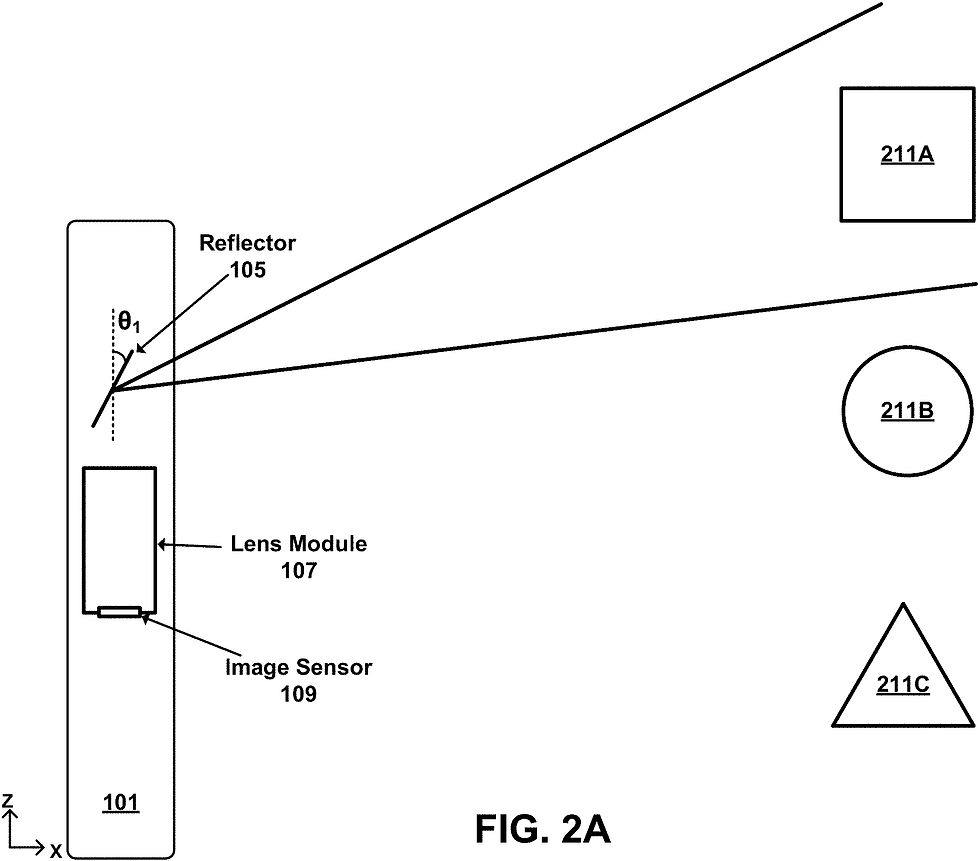
A. What is the invention?
The invention is a new imaging system that is designed to be integrated into mobile devices like smartphones. The key components are:
- An image sensor
- A rotatable reflector that directs light from the external environment towards the image sensor
- A controller that rotates the reflector and synchronizes the image sensor to capture images of different portions of the external environment
B. How does it work?
The reflector is positioned to direct light from the external environment through the window of the mobile device housing towards the image sensor. The controller rotates the reflector about an axis to direct light from different portions of the external environment onto the image sensor. It synchronizes the image sensor to capture images of these different portions as the reflector rotates. The controller then combines the captured images to form a larger, continuous image of the external environment.
C. What is new?
The key new aspects of this invention are:
1. The positioning of the large, high aspect ratio image sensor perpendicular to the mobile device housing window, enabling a larger sensor size.
2. The use of a rotatable reflector to direct light from different portions of the view onto the image sensor.
3. The synchronization of the image sensor capture with the reflector rotation to enable stitching of the captured images.
D. Why is it useful?
The imaging system provides several benefits compared to conventional mobile device cameras:
- Larger image sensor size for improved image quality
- Wider field of view by capturing and combining multiple image strips
- Ability to compensate for motion of the mobile device during capture
- Ability to capture images of the environment in front of and behind the device These features enable the imaging system to produce higher quality, wider field of view images in a compact mobile device form factor.


Comments