
Rolex, Omega, and Audemars Piguet: from patent trends to patent exploration
Updated: Apr 14, 2025
The Swiss watch industry has been around for more than a century, and I am always fascinated to see how these luxury brands constantly manage to innovate and improve the precision of their mechanical watches.
In terms of patents, there is sometimes breaking news emerging in the media, such as the Spirate balance spring in 2023 from Omega, enabling (in theory) a regulation below ±2 seconds/day, or the amazing monoblock silicon oscillator from Zenith introduced in 2017 (it's getting old but is still is so futuristic);
But it is really hard to get the big picture of respective brands' innovation trends.
Conventional patent landscape is a great way to better grasp such a big picture. There are nevertheless strong limitations as these landscapes mainly rely on citations, keywords, or patent classification. This is where AI patent landscape brings way more precision and granularity. Let's explore the topic with a practical example:
Let's say we want to see how the patent portfolios of Rolex, Omega, and Audemars Piguet have evolved over the last five years (2020-2024). A total of 349 patent families are identified, and the landscape looks as following:
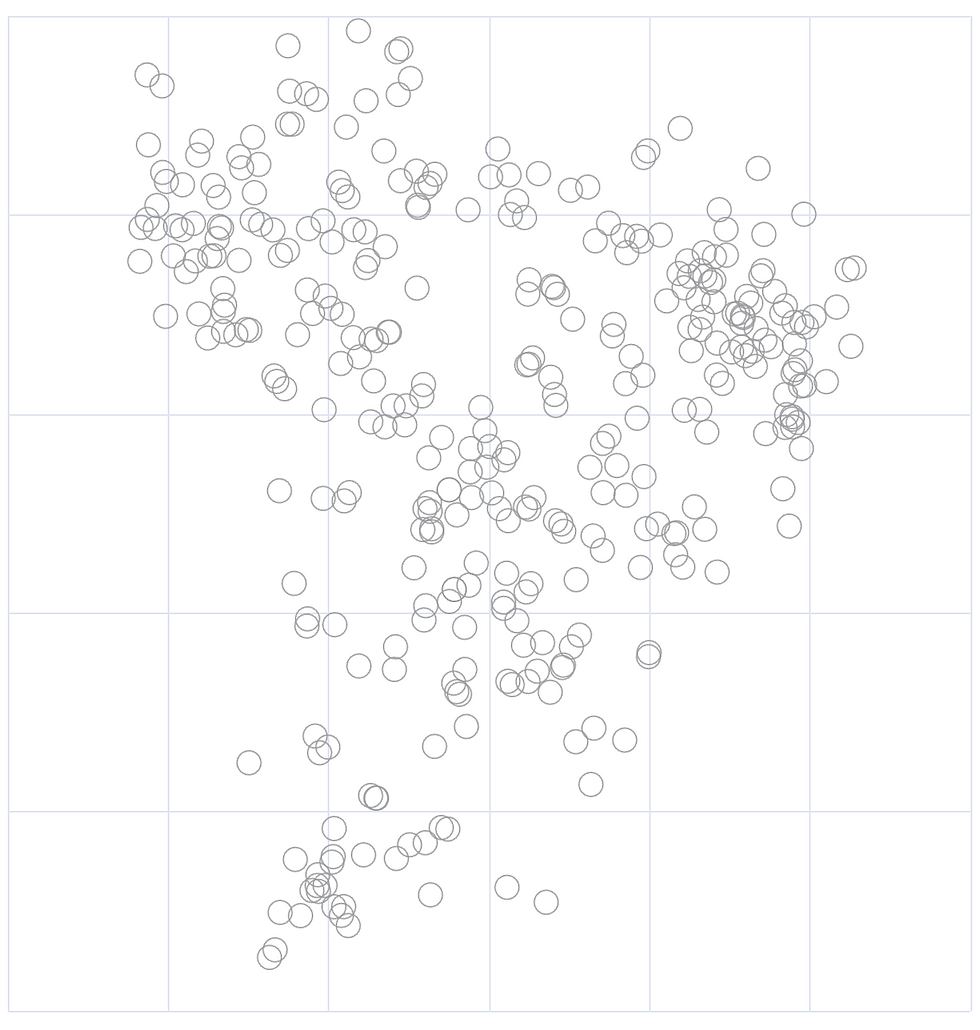
Let's see now how the portfolios of each brand compares:
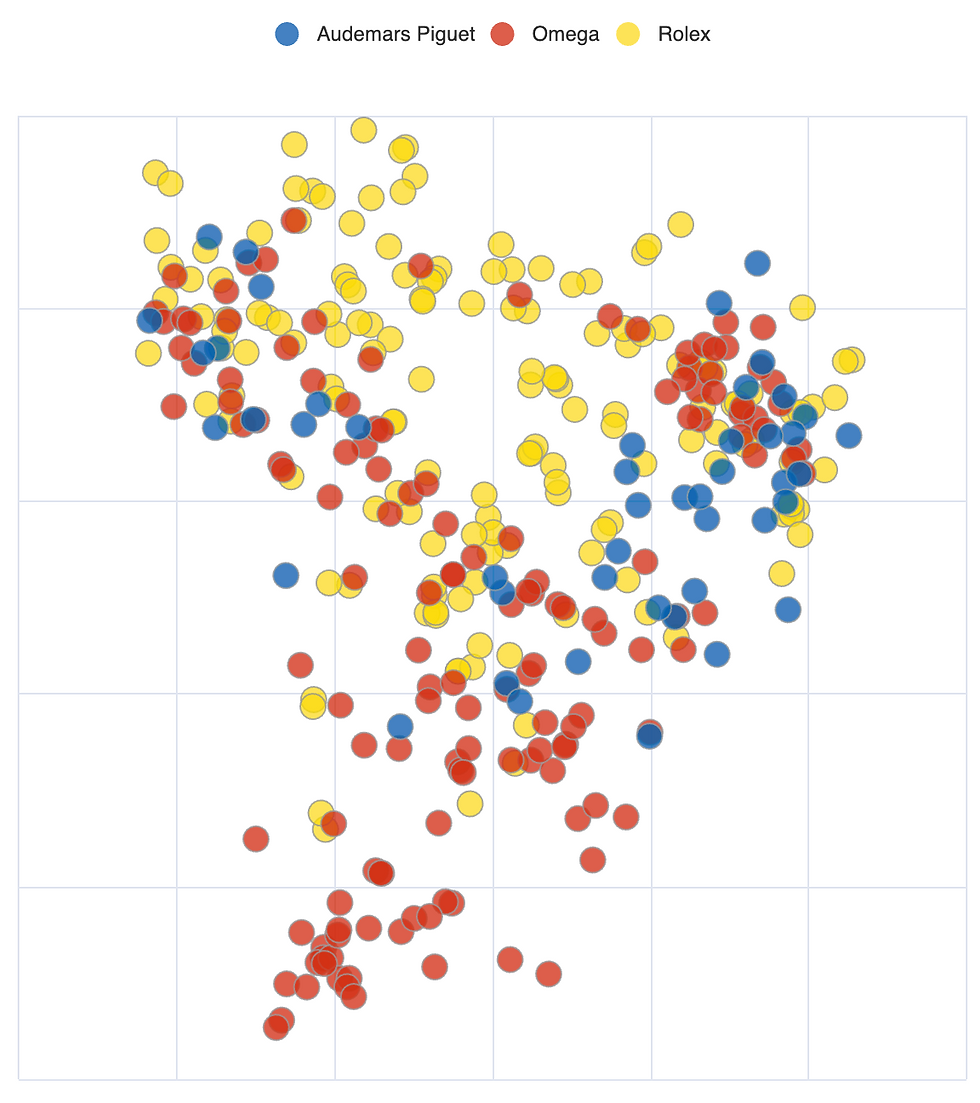

Rolex's patent portfolio is quite dense, as depicted in yellow. Omega, shown in red, overlaps significantly with Rolex's portfolio but is less dense. Notably, Omega has a somewhat independent cluster of patents at the lower part of the landscape. Finally, Audemars Piguet, represented in blue, shares much of its territory with Omega and Rolex, with only a few distinct areas.
Let's focus on the most obvious breakaways:
The most obvious cluster is related to watch thermal regulation. Knowing that the most importatn environmental factors impacting the watch precision are the a. the gravity and position, b. magnetism c. temperature, this cluster is very intersting and easy to interpet. Here is one granted patent of this cluster: US12078968B2. This patent protects an isothermal clock device in which the mechanical or other functional parts (2) are located in a case (6) which is itself located inside a casing (4) and fixed through reversible fastening means (7) to minimize the heat transfer transferred from the outside to the inside of the watch through conduction. The reversible fastening means signify that the fixation is non permanent and that the case (6) can easily be disassembled and reassembled with the casing (4).

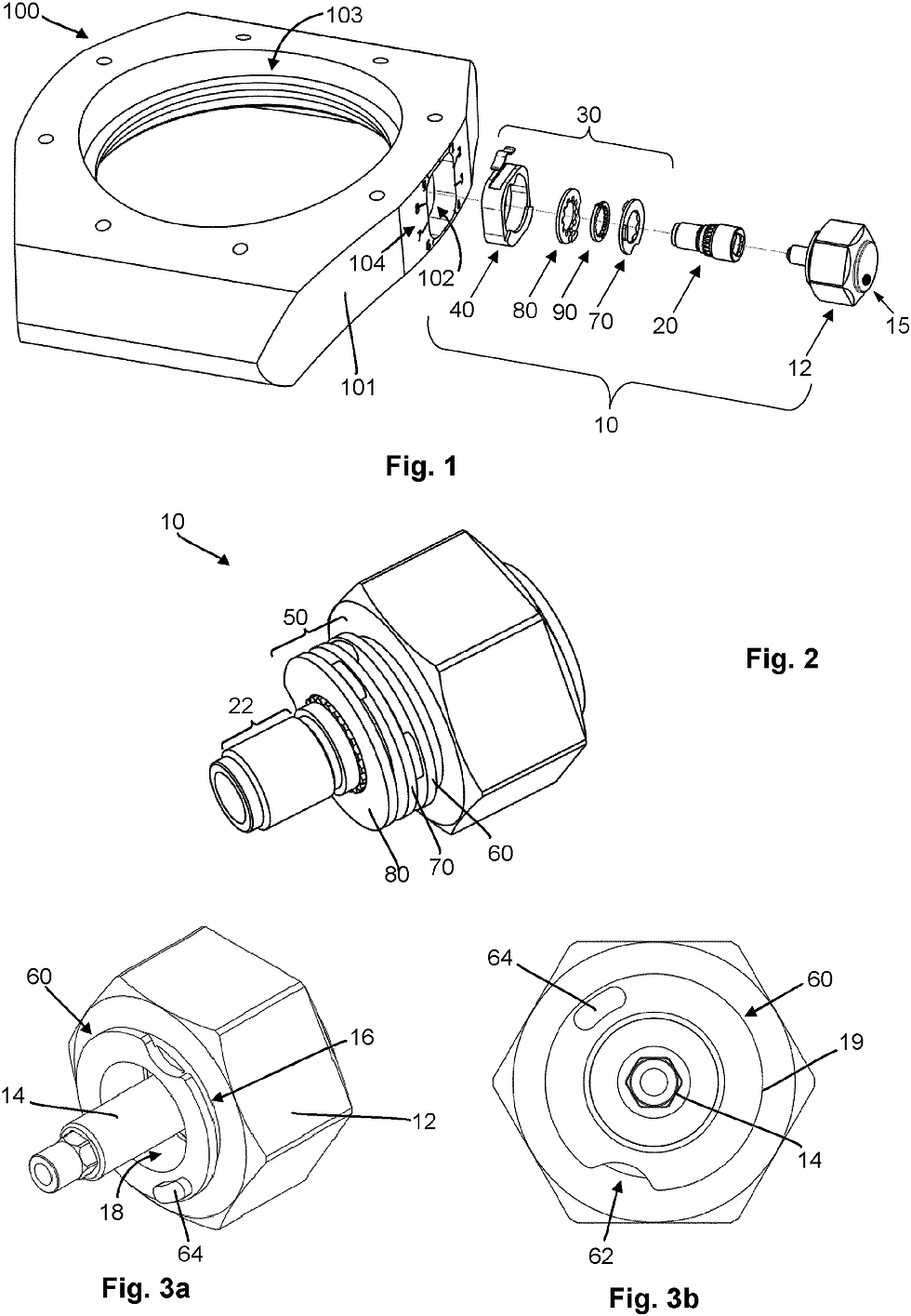
In addition, we can also see some crown and near crown mechanisms patents. Let's have a look at how Audemars Piguet's combination locking mechanism work (patent pending EP4484681A1 published on January 1st 2025):
1. The user first turns the crown 12 clockwise by at least two complete rotations. This positions the discs 60, 70, 80 in a reference starting position.
2. The user then turns the crown in a specific sequence of clockwise and counterclockwise rotations. This sequence is designed to align the cutouts 62, 72, 82 on the three discs in a predetermined combination.
3. For example, the user may first turn the crown clockwise to align the indicator 15 with the index corresponding to the first digit of the combination code. This positions the cutout 82 on the third disc 80.
4. The user then turns the crown counterclockwise to align the indicator with the index for the second digit, positioning the cutout 72 on the second disc 70.
5. Finally, the user turns the crown clockwise again to align the indicator with the index for the third digit, positioning the cutout 62 on the first disc 60.
6. When all three cutouts are aligned, the contact pad 43 on the lock 40 can retract into the aligned cutouts, allowing the lock to move to the unlocked position and release the crown.

We can continue our patent journey by using Omega's US12078968B2 as an AI patent search input an look for the 100 closest patents (still between 2020 and 2024). This is how the Top 100 looks like:
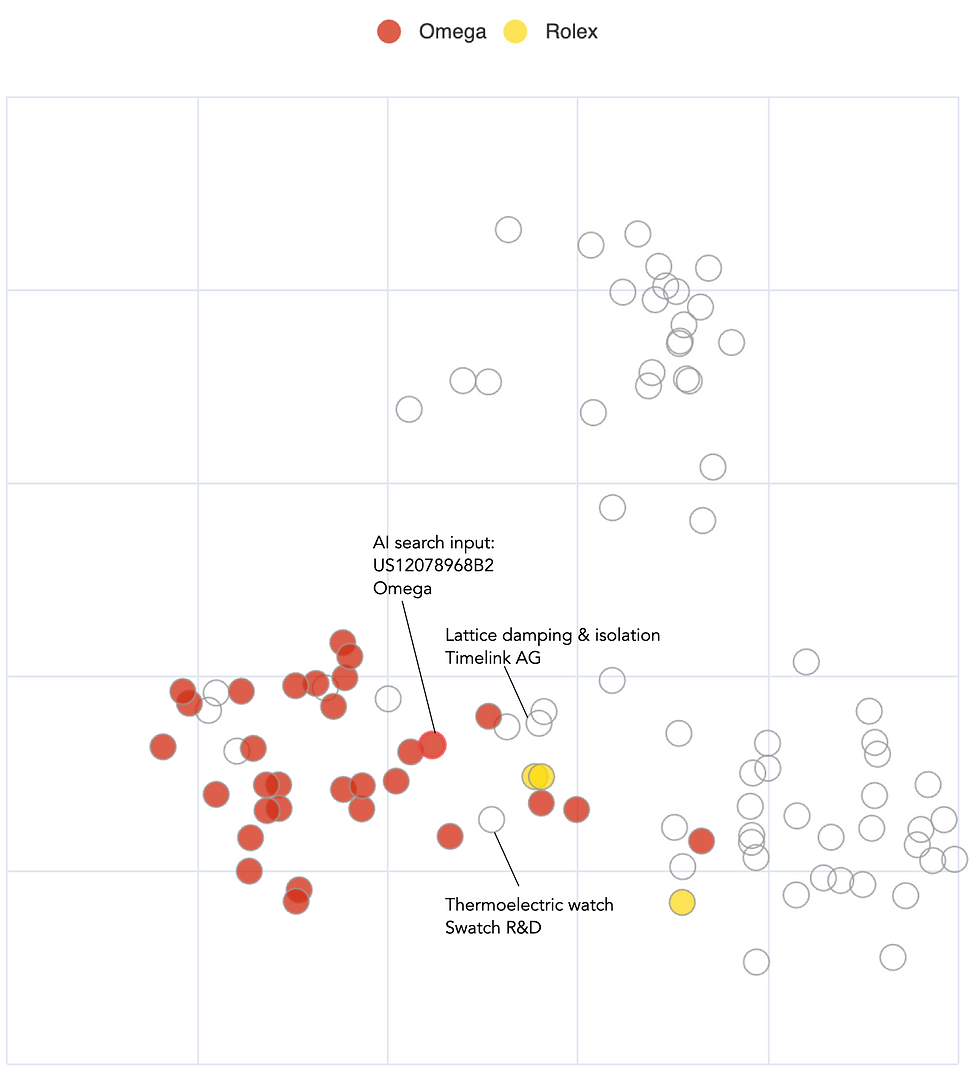
As you can see, I have indicated the patent used as an input of the patent search US12078968B2 as well as two neighbouring patents of interest. The first one is from Timelink AG (EP3631582A1) which is very close to Omega's input patent but comprises a lattice fixation (230) holding the watch movement and ensuring both; damping in case of shock; and a strong thermal insulation to decrease the variation of the watch oscillation frequency that is directly related to thermal variations.

The second one US11573534B2 is from Swatchgroup Research and Development and the title speaks by itself: "Thermoelectric Watch" here are its key components and basic functioning:

1. Thermoelectric module: This includes a hot plate and a cold plate connected by semiconductor pillars. The hot plate is thermally connected to the watch's back cover, while the cold plate is thermally connected to the watch case middle.
2. Support element: This has at least two flexible branches that connect the cold plate to the watch case middle. The branches act as shock absorbers to protect the fragile thermoelectric module.
3. Back cover: This has a conductive part that contacts the user's wrist and directs heat flux to the thermoelectric module. It also has an insulating part to limit heat flow that doesn't go through the thermoelectric module.
The temperature disparity between the hot and cold plates of the thermoelectric module generates an electrical voltage via the Seebeck effect.
This voltage is then used to power electrical components in the watch, such as an actuator or other electrical component. The flexible support element and the design of the back cover are key innovations that help optimize the thermal and mechanical performance of the thermoelectric power generation system.
This is extremely interesting and could potentially lead to smartwatches with extended battery life or even watches with virtually infinite autonomy as long as they are worn regularly.
If we step back a bit and look at the big picture, we can think about using this technology in other relevant contexts such as IoT, connected apparel, or remote sensing on birds, mammals, or even insects.
The patent search highlighted above demonstrates how intuitive and engaging it becomes with the use of AI. It allows for a rapid comprehension of the overall patent landscape and facilitates navigation to uncover new trends or emerging technologies that offer advantages across a wide range of applications. AI patents are not only powerful strategic assets but also provide new creative tools for engineers, inventors, and entrepreneurs to explore the latest technological trends in their areas of interest and beyond.
If you have a product or invention idea and want to explore existing patents to quickly evaluate its freedom to operate or novelty, or if you're interested in examining existing solutions during the early ideation phase, assessing your position against competitors, or conducting an in-depth analysis of your patent portfolio, reach out to me here ⬇️


link link link link link link link link link link link link link link link link link link link link link link link link link link link link link link link link link link link link link link link link link link link link link link link link link link link link link link link link link link link link link link link link link link link link link link link link link link link link link link link link link link link link link link link link link link link link link link link link link link link link link link link link link link link link link link link link link link